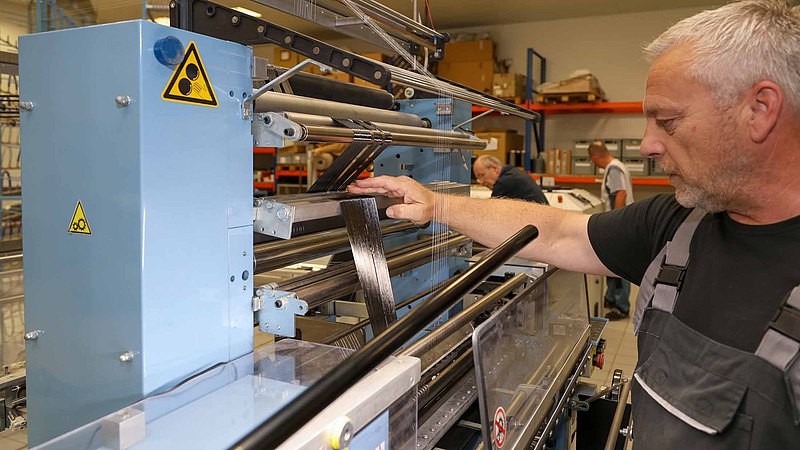
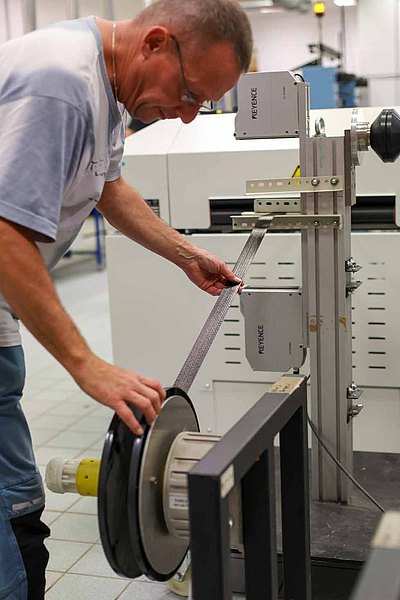
Maximum strength with minimal weight - that is the gold standard in lightweight construction. It must also be resource-efficient and sustainable. But first and foremost, materials must withstand mechanical stresses exactly where they occur - whether in aerospace, on roads or railways, in sports, in wind power generation, or in hydrogen storage. In all these applications, unidirectional reinforced tapes can be used to create load-bearing reinforcements.
This versatile semi-finished textile product has long been a key area of research at the TITK in Rudolstadt. At the K 2025 plastics trade fair in Düsseldorf, the industry-oriented institute showcased newly developed dry narrow-web fabrics based on 50K carbon fiber rovings. Dry UD tapes made from parallel-aligned continuous fibers were produced using specially adapted sewing threads and an optimized heat-setting process, and were processed using an automated, robot-assisted tape-laying method.
The textile and materials researchers at TITK have also developed considerable expertise in automated tape winding. Current research focuses on pressure vessels for media storage as well as a wide variety of other 3D structures. The robot-assisted system at the TITK technical center allows for the construction of a wide variety of composite structures, enabling the layer structure to be implemented very flexibly for either full-surface or variable coverage. “We can replicate the entire process chain here, and on a fairly large pre-industrial scale,” says department head Dr.-Ing. Thomas Reußmann.
These technical capabilities are now complemented by a 3D print head for the existing robot. “This makes it possible to reinforce the deposited tape layers with custom plastic structures at precisely defined locations along the load path,” Reußmann explains. Alternatively, a prototype mold can first be printed from plastic granules, and the tape can then be deposited onto it, adds Dr.-Ing. Robert Hartmann, a research associate in the Department of Textile and Materials Research.
If necessary, the subsequent resin infiltration of the laid-up tape structures is also carried out directly at TITK. And last but not least, TITK’s subsidiary OMPG - an accredited testing laboratory for plastics and textiles - conducts important on-site material tests for rovings, tapes, and finished components, enabling targeted adjustments to be made during material development.
The TITK will showcase related exhibits - such as laid-up tape structures made from carbon fiber rovings and a wound composite body - at Fakuma from October 12 to 16, 2026, in Friedrichshafen at the Thuringia booth in Hall A4 (Booth 4229).