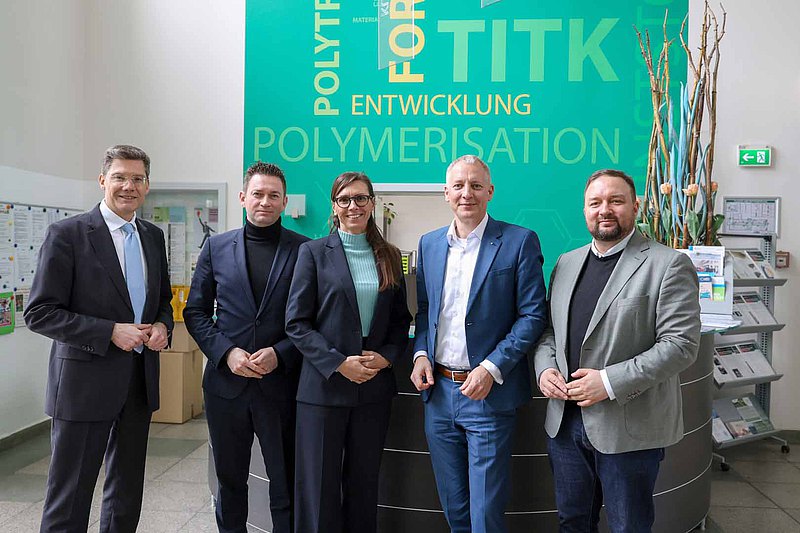
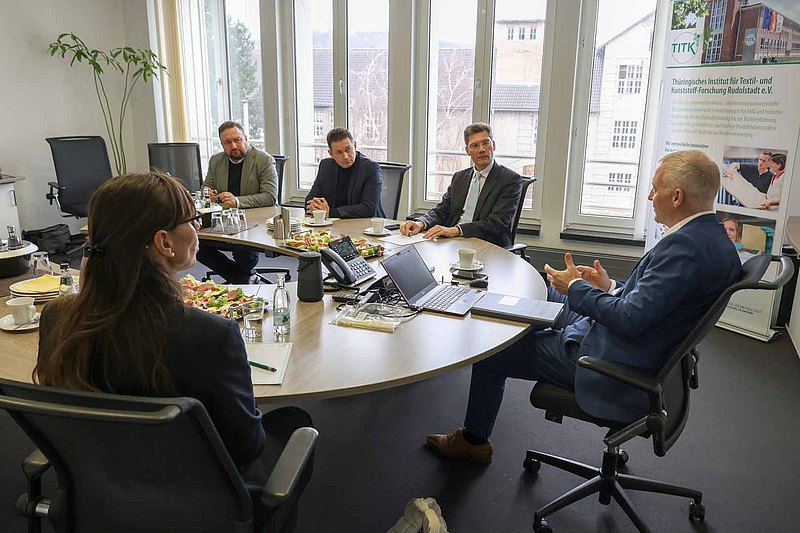
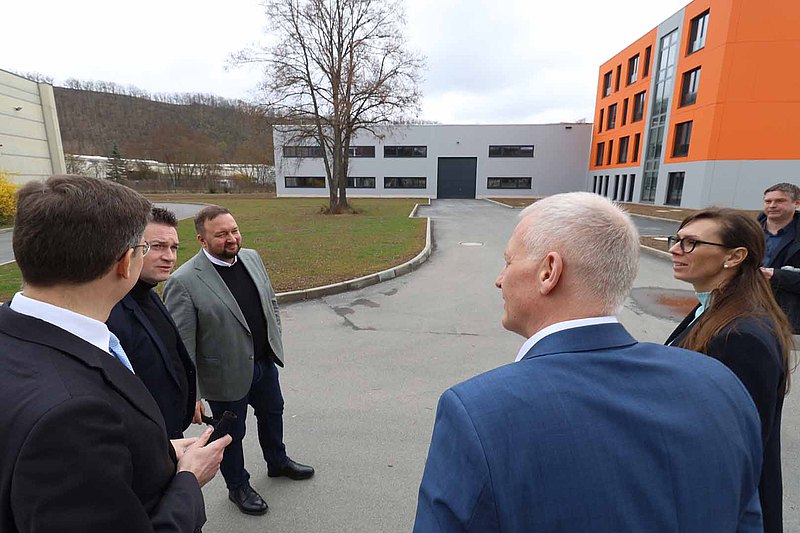
When do you ever get the chance to welcome four members of parliament all at once? During their joint constituency tour of southeastern Thuringia, the CDU members of the Bundestag from the Free State of Thuringia stopped by the Thuringian Institute for Textile and Plastics Research in Rudolstadt on Tuesday. They discussed numerous topics with Institute Director Benjamin Redlingshöfer - ranging from the current framework conditions for research funding to the challenges and potential of the defense industry.
Rudolstadt – The discussion was extremely constructive and took place in a confidential atmosphere between the head of the TITK and Christian Hirte, Parliamentary State Secretary at the Federal Ministry of Transport, David Gregosz, a member of the Committee on Internal Affairs and the Committee on European Union Affairs; Michael Hose, a member of the Committee on Education, Family, Senior Citizens, Women, and Youth and the Committee on Culture and Media; and Diana Herbstreuth, a member of the Committee on Defense and the Committee on Economic Cooperation and Development.
Benjamin Redlingshöfer thanked the members of the governing coalition for the new regulations regarding the prohibition on better pay: “Since 2021, this has tied up significant resources in industry-linked research institutions - resources we would much rather invest in innovation,” said the TITK director. Under the prohibition on preferential treatment, institutions that receive grants are generally not allowed to pay their employees more than comparable federal employees. In January, the cabinet initiated a move toward greater flexibility: It approved an amendment to the Freedom of Science Act, which now places project-funded, non-profit research institutions on an equal footing with other institutions. “This ultimately results in equal treatment of industry-oriented research institutions, such as those in the Thuringia Research and Technology Network (FTVT), with the non-university research networks Fraunhofer, Leibniz, Helmholtz, and Max Planck,” Redlingshöfer said with satisfaction.
“The business-oriented research institutions in the Free State are the institutions with the highest level of technology transfer in Germany,” he emphasizes. Due to the lack of base funding, they are virtually forced to succeed: “They must be successful in securing project grants, but in addition to public funding, they absolutely need co-financing from industry.” The TITK director views the fact that researchers consequently have no choice but to focus on the right topics - those with market relevance and a strong results-oriented approach - as a valuable regulatory mechanism. However, he argues that this very necessity requires reliable framework conditions - namely, continuity in project funding and a budget-secured adjustment for inflation and salary costs. “Otherwise, the innovation momentum of small and medium-sized enterprises in particular will ultimately suffer.” Redlingshöfer also addressed research funding through tax incentives and made concrete proposals on how this instrument can provide even more targeted support as a complement to project funding.
Get involved in security and defense research
Discussions also focused, for example, on the positive development of the Konrad Zuse German Industrial Research Association, which was founded more than ten years ago, also initiated from Rudolstadt. As one of more than 80 research institutions now united under this umbrella - though not the only one - the TITK also aims to have a say on the highly topical issue of security and defense. Redlingshöfer sees these medium-sized institutes as virtually predestined to produce “small and medium-sized quantities of highly complex items.” However, he notes that it is essential to allocate available funds in such a way that civilian benefits can also be derived from defense research projects. “At the same time, it is urgently necessary to significantly streamline and reduce the bureaucracy in procurement processes. Otherwise, the efficient use of funds is jeopardized, and the participation of new players and small and medium-sized enterprises is hindered.”
Research and business need predictability
Member of the Bundestag Diana Herbstreuth, who served in the Bundeswehr from 2001 to 2025, could only agree: “Especially in times of economic uncertainty, tight budgets, and major transformation processes, research institutions and companies need, above all, planning security.” Institutions like the TITK must be given the necessary freedom and support to bring future technologies to market, Herbstreuth said.
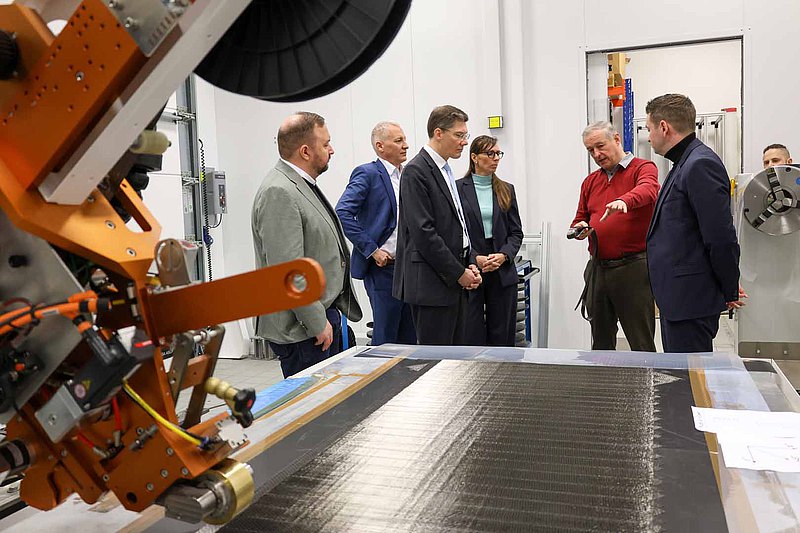
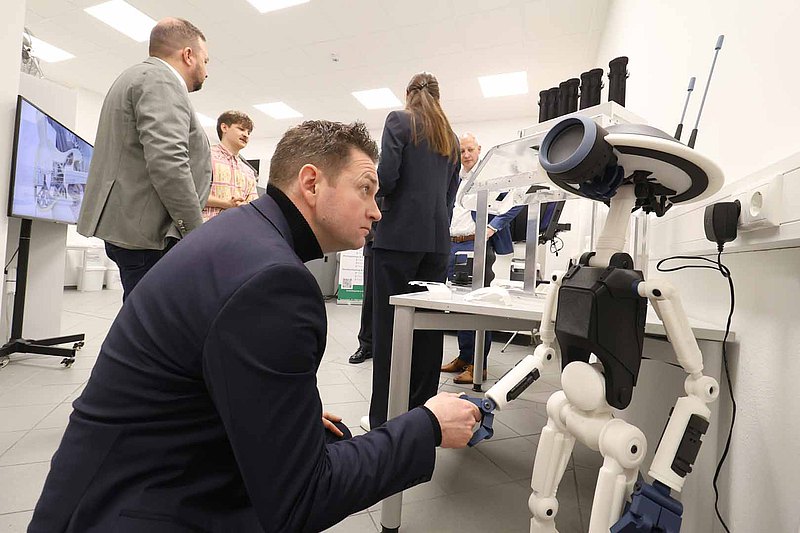
During a tour of various laboratories, the lawmakers concluded their visit by gaining firsthand insight into the institute’s current research projects and witnessed, among other things, cutting-edge technology in the form of robot- and laser-assisted tape laying. As they departed, Diana Herbstreuth remarked, visibly pleased: “I am particularly impressed by the practical focus and innovative spirit of the work being done here in Rudolstadt. The TITK exemplifies what sets Thuringia apart: strong research, entrepreneurial thinking, and the determination not only to develop solutions but also to put them into practice.”