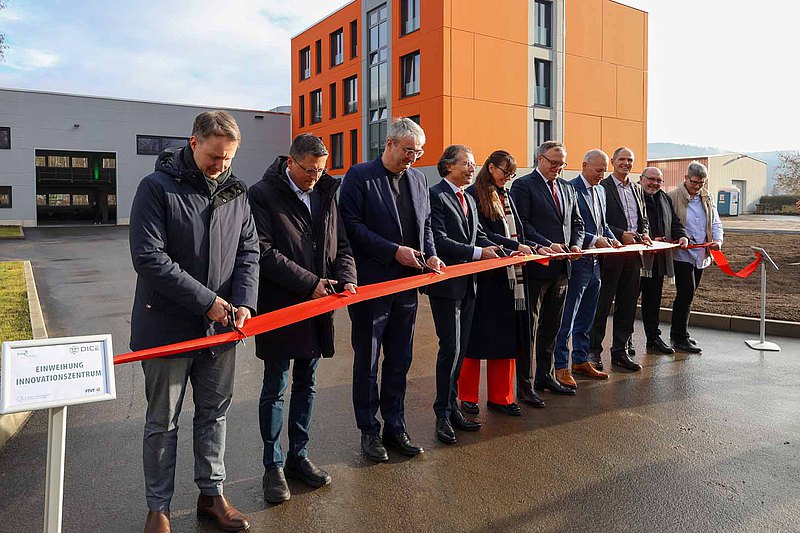
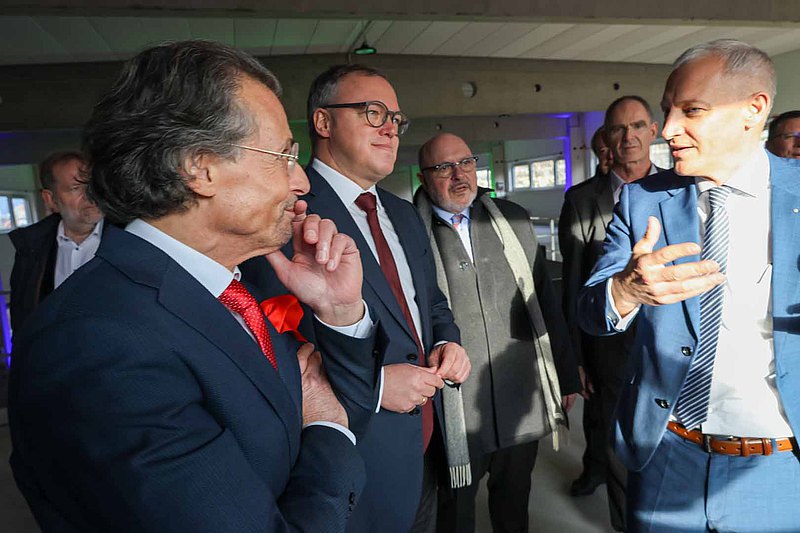
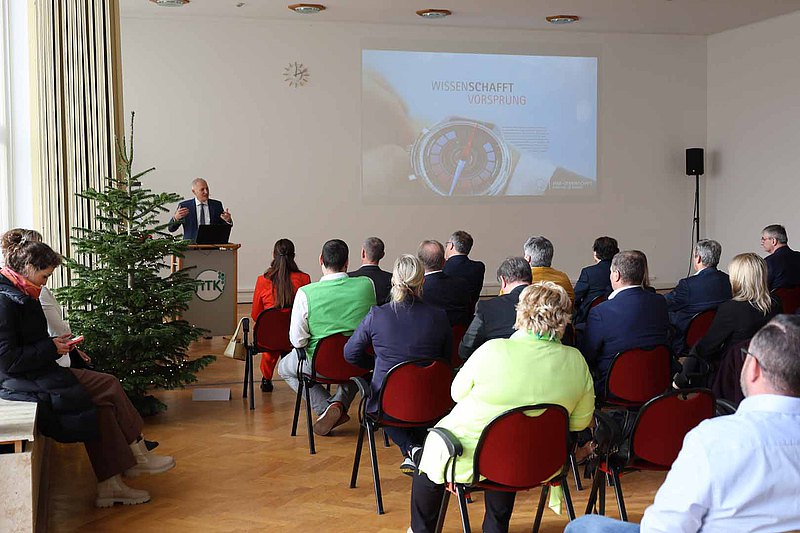
Just over eight months after the foundation stone was laid, the new Innovation Center for Textile Circular Economy was officially inaugurated today at TITK Rudolstadt. Thuringia's Minister President Mario Voigt, TITK Director Benjamin Redlingshöfer, and other guests of honor cut the ribbon to the modern building complex and viewed the premises, which are now ready for occupancy. The “DICE – Demonstration and Innovation Center for Textile Circular Economy” is TITK's largest single investment to date. The Free State of Thuringia supported the total cost of €11.5 million with €8 million in GRW and FTI funding.
Rudolstadt - The rapid progress of construction on the institute's grounds has been a source of amazement for the employees of the TITK Group since spring. “We were always on schedule and within budget,” says TITK Director Benjamin Redlingshöfer. His announcement shortly after the laying of the foundation stone on March 31 that invitations to the inauguration would be sent out before the end of the year initially elicited skeptical smiles from some. But the promise was kept: “That was real ‘Thuringia speed,’” says Redlingshöfer proudly. The construction project was carried out by companies from the Free State.
Minister President Mario Voigt says: "The DICE is a strong signal for Thuringia's innovative strength: research is put into practice here, ideas become industrial solutions. In just eight months, visions have been turned into a center for visions. The rapid implementation shows that we in Thuringia not only have commitment and expertise, but also set a clear direction for the future with speed and efficiency. Innovative, sustainable, and competitive. The Free State of Thuringia has deliberately provided significant support for this forward-looking project because we want to further strengthen Thuringia as a location for research and development. I would like to express my sincere thanks to all those involved—the construction workers, the planners, those responsible at TITK, and all funding and project partners—who made this success possible. They have all set out to further advance the Green Heart of Germany and make it future-proof for the citizens of our state."
The result is a four-story laboratory and office building and a test hall, each with a floor space of around 1,000 square meters. The barrier-free new building will house a biology laboratory and a pulp laboratory, among other things. The hall will focus on two main areas: polyester recycling and cotton recycling. In addition, research and testing of alternative pulp suppliers will also be a focus. Thanks to DICE, the TITK Group will have its own pulp cooking system in the future. This plant is currently still under construction in Saxony and is scheduled to go into operation in 2026.
The TITK director is convinced: “DICE will be the leading national and international innovation and demonstration center for research and development of environmentally friendly processes for the production of chemical pulp, the production of sustainable cellulose fibers, and the development of the necessary solution spinning technologies.” Redlingshöfer sees this as further proof that Thuringia is increasingly setting the pace for the German innovation landscape. “We have nothing to hide here.”
Important contribution to the transformation of the textile value chain
For more than 30 years, TITK has been dedicated to sustainable cellulose-based textile fibers. These Lyocell fibers have already undergone significant further development: they no longer use only wood pulp, but also, for example, fast-growing hemp, which consumes few resources. This year, the institute has taken a major step forward in developing innovative solutions for practical and holistic textile recycling: at the World Expo in Osaka (Japan), Redlingshöfer personally presented the world's first polo shirt made from triple-recycled hemp Lyocell fiber (Lyohemp®).
The Rudolstadt-based institute aims to make an important contribution to the transformation of the textile value chain. The recycling of mixed textiles in particular is a key challenge that the new DICE innovation center will address. “Closed regional material cycles are our goal,” says Redlingshöfer. “But they must be ecologically and economically viable in order to guarantee market success.” The focus of the innovation center does not end with sustainable fibers for clothing textiles, but also explicitly includes technical textiles for high-performance applications in the automotive, aerospace, and defense sectors, for example. “Here, regionality also represents a resilience factor,” says the institute director.
To date, 63 partners have agreed to cooperate with DICE, including well-known companies such as Adidas, Vaude, Continental, and Head, as well as other research institutions, associations, and networks.